

I was flipping through Simple Times by Amy Sedaris and fell in love with the embroidering by Megan Whitmash. Embroidered lettering has been in the reigns of old people for far too long, right? Can we (the youthful vital ones) please take these trades (scrapbooking, calligraphy, embroidering) back.
Check out more of Megan’s work. It’s incredible.


My love of letters means I’m always in war with the Post Office—-picking up missed deliveries, tracking late deliveries, dealing with with customer service that makes me feel like a serf in a feudal society, etc. Maybe if Jan Vormann worked his dispatchwork on the Brooklyn post it wouldn’t be sooo bad. Please fill the cracks of my postoffice with legos.


This weekend I completed two belated cards I’ve been shrugging off for some time now. My best friend and my brother recently had Birthdays met with postal silence from me. It’s always difficult to make anything for my creative, talented friends and family. It always feels like a lot a pressure. I’m slowly realizing, with calligraphy, perfection is not the point. Yes it’s an art, but that’s a minor detail. Letter writing is primarily about making your recipient feel (for lack of better and less cheesy words) loved. Smudges, fireworks, and shaky lines are allowed. If you have fun and go with your natural instincts, the right message comes across.
My favorite letter is Joel’s. I did a water color of a welsh corgi, his animal obsession, and Ms. Woman of the Tiny Fuppets (a hilarious spin-off of the Muppets in Portuguese). I can’t wait for him to get it!
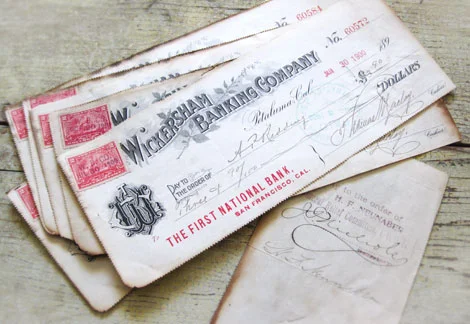


I saw a lovely idea today on Just Something I Made on how to use Vintage Checks into decorative labels. Basically scan, print, stain, perforate, and glue. I’m a bit obsessed on the style of checks and old invoices. I wish my checkbook looked like this. I suppose it’s better suited for the flowers. Sigh.

Isn’t this clever? I never thought of only bolding the capitals. Kinda reminds me of the french postcard I posted yesterday. Three cheers for Castle Calligraphy!

Signature.
I’ve always had a problem with signatures. It takes a lot of coaxing for me to even consider it, and if I do cave I usually just sign my name in tiny letters on the back. My hesitation stems from working with a lot of emphasis on composition and sparseness and because I find it sort of redundant. If I worked in oil and painted rich landscapes or filled up the whole canvas, I probably wouldn’t be irked to pen my name down in the corner. But when you sit their obsessing over surface cleanliness and correcting stray marks, having someone ask if you’ll scratch your name in the bottom really gets to me.
I say I find it redundant because if you work in a relatively consistent style, whats the point of a putting your name down there? I really enjoy your first encounter with a piece by an artist you’re obsessed with, how you have no doubt whose hand did those trees, those feet, even though you’ve never seen the work before.
Essentially, I’d like my signature to be the hands that crafted it. Like the brilliant and nameless artists of ancient times, who are only remembered for the accidental fingerprints left in their work.


French Calligraphy. I like the way the pen bleeds on these—-just a (oui) bit.
Source: French Kissed


Every December from 1920-1943, J.R Tolkien’s children would receive one letter in the fire place from Father Christmas. The letters themselves were illustrated and written by Tolkien with beautiful detail. He hand lettered the envelopes and created lovely postal stamps from the North Pole.
Like every character Tolkien has ever created, Father Christmas was complex. His letters didn’t shy away from mentioning the war or England’s political turmoil.
In 1939, he wrote to Priscilla Tolkien “I am very busy and things are very difficult this year owing to this horrible war. Many of my messengers have never come back. I haven’t been able to do you a very nice picture this year.”
Houghton Mifflin has made Tolkien’s letters into a beautiful book. Buy it, and check out the article from the New York Times. It’s been a while since I’ve seen something so sincere, charming, and beautiful—-this is the sugar of life.

This is a picture of the most valued stamp collectible. It sold for almost $3.5 million dollars!
“First on our list is a swedish stamp issued in 1855 and most ironically the world’s most expensive is actually a printing error as it should have been printed in green which was indicating its three skilling value instead of yellow which was meant for eight skilling stamps. Because of its rarity this stamp sold in 1996 for no less than 2.5 million swiss francs”
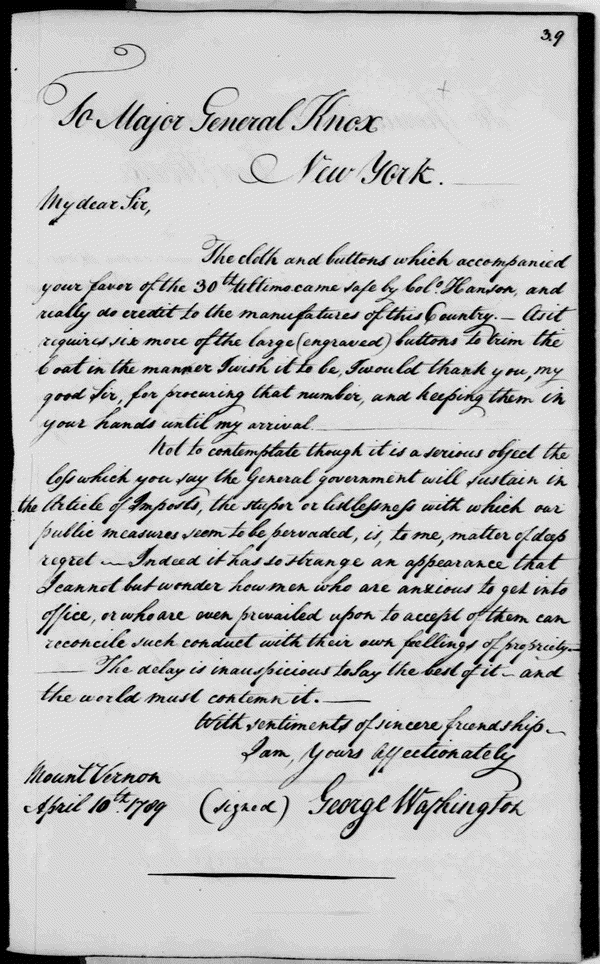
A letter from George Washington, a man who took the time to embellish the corner of every letter.
Source: American Memory

Father Ryan’s Bathroom by Josh Cave.
Life in the cloisters.


Scrapbooks can be cool. I’m using this pick as inspiration for a current project I’m working on. Wouldn’t you like to leave something like this behind?

Elton John calligraphy?
Source: Joni Jaimes

Betsy Dunlap love!

“Original legal complaint, in which Mark Twain sues the owners of a Brooklyn department store for their unauthorized and deceptive use of his name and image to publish and sell books, signed “Samuel L. Clemens.” With interesting related correspondence—one envelope with an autograph note by Twain to his lawyer: “Just received. That disastrous book seems to be traveling, you see. SLC.”
Credit: Bauman Rare Books


I’m so tempted to buy these vintage unused stamps! My cabinet will be one great deluge of postage but that can hardly be helped? These guys are beautiful! Looking good Abe.
Source: Verde Studio

How Brilliant are these invitations by Betsy Dunlap? Ah, god speed my typewriter. Lovely work!


J.K. Rowling’s seventh Handwritten copy of The Tales of Beedle and Bard sold for 4 million dollars! All proceeds went to The Children’s Voice Campaign. The other six copies were gifts to those who worked closely to aid in the creation of Harry Potter. I didn’t even know these treasures existed. Genius!
“
So how do you review one of the most remarkable tomes you’ve ever had the pleasure of opening? You just turn each page and allow yourself to be swept away by each story. You soak up the simple tales that read like Aesop’s fables and echo the themes of the series; you follow every dip and curve of Rowling’s handwriting and revel in every detail that makes the book unique—a slight darkening of a letter here, a place where the writing nearly runs off the page there. You take all that and you try and bring it to life, knowing that you will never be able to do it justice. With that, let’s dig in and begin at the beginning, shall we?”—Daphne Durham